



Alternative subcultures like punk and goth are more than dyed hair and dark clothing. However, with the rise of “fast fashion” online clothing stores and the spread of social media like TikTok and Instagram, it is now easy to adopt a look that has nothing to do with the original meaning.
What was once about individuality, community, and resistance is now an aesthetic that can be bought with a click. The subculture is now mainstream and has completely lost its original, unique meaning.
Punk was started in the mid-1970s to combat issues within society’s standards. Punks had strong political beliefs that they shared through their music and style.
The punk subculture started in underground clubs in New York and London, and was a rebellious, anti-establishment movement. The musical style was raw and aggressive, and there was a distinctive anti-fashion aesthetic. Punks were known for a strong DIY (“do it yourself”) ethic.
Punk fashion was designed to be shocking, and it was anything but mainstream. This continued into the 1980s and 1990s. Punks were known by their ripped clothing held together with safety pins, Doc Marten boots and aggressive jewelry, including spikes and chains.
(Violet Churchill)
Over the past 20 years, the commercialization of alternative subcultures has completely changed their original meaning. In the case of subcultures like punk and goth, companies have realized that they can make a lot of money by taking the aesthetic and turning it into products for mass consumption.
The commercial version of these subcultures promotes the visual aesthetics over the ideas of individuality and resistance. This has been accomplished through the use of social media, the increase in inexpensive manufacturing, and the ability to sell anything and everything online.
While punk was meant to be anti-establishment and anti-mainstream, today companies are marketing the aesthetics and making them easily accessible through places like TikTok and Instagram, as well as stores like Aliexpress, Dolls Kill and Romwe. This is the opposite of the original DIY approach to fashion and music embraced by the punks of the 1970s.
For example, on the Dolls Kill website, they have a collection of plain black clothing pieces with different charms attached to the items. The clothes are sold for high prices, ranging from $60 to $300, when someone could easily make them from items they already own.
Making homemade clothes is part of the DIY experience in many subcultures. The fact that a company is selling the same look for a significant profit shows how commercialization is impacting the subculture.
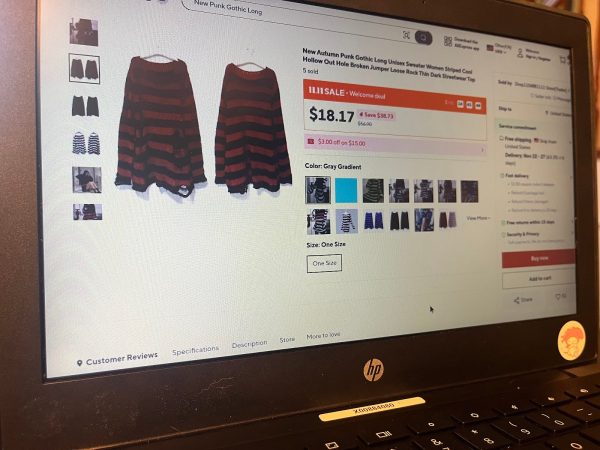
In another example, the Aliexpress website sells a “punk gothic sweater” with rips and holes, modeled after a style preferred by punks in the 1980s. The company is profiting from cheap manufacturing and copying authentic subcultures.
Because of these companies using punk and goth subcultures to make quick money, the main purpose of the subcultures has been lost, and people now see it as nothing more than an aesthetic.
While the problem of commercialization cannot be easily solved, individuals in the punk and goth communities still have many options today to express their individuality and resistance. They can DIY their own fashion by thrifting and making clothes and refuse to support online companies making a profit on the aesthetics of the subculture.




Yazmin ◊ Nov 21, 2025 at 10:54 am
I agree too much Violet! I really love how in depth you went into this topic, as a alt person myself trying build up my closet; the substyles are being exploited by capitalism making it highly unaffordable to people like me.